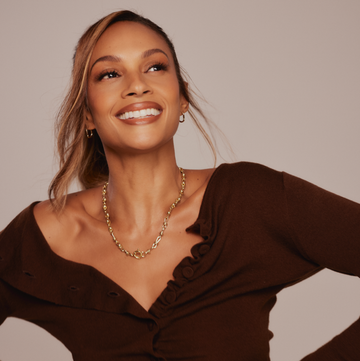
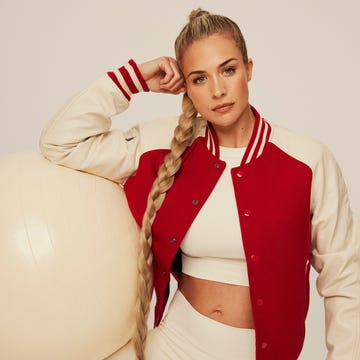
It’s with the affection of an old friend that Liz Earle greets the barbell. We’re into hour eight of her first Women’s Health cover shoot – a shoot that’s seen her hang from gymnastic hoops, hold her body weight on a pull-up bar and do the battle ropes in six-inch heels. But if the 63-year-old mother-of-five is feeling the burn, she doesn’t show it. Kicking off her heels, she strides towards the barbell and begins to lift with a practised poise that – were you to bottle it – would outsell even the duck-egg blue tubes of Cleanse & Polish, the hero product of the skincare brand she co-founded more than three decades ago, one of which is purchased every 16 seconds.
It isn’t until I speak to her from the light-filled former artist’s studio near Battersea Park that serves as her workplace – her home is in Dorset – that it occurs to me: perhaps she feels a responsibility to show up this way. ‘One of my great frustrations is that women often become almost invisible just as they’ve accumulated decades of knowledge and experience,’ she begins, before adding – for the avoidance of doubt – ‘Midlife isn’t a winding down; it’s a stepping up.’
It’s a topic in which she’s something of a specialist. For while her name may still be synonymous with the beauty brand from which she’s long since stepped back, she’s been quietly building a wellness empire. The wellbeing platform she launched in 2013 now boasts a community of more than 200,000 across her social profiles, with another 60,000 subscribers to her YouTube channel. She’s authored an eye-watering 37 books on topics from gut health to menopause – with her longevity-focused latest, How To Age, published in April – and her podcast, Age Better With Liz Earle, has had 12m downloads. Not bad for a woman who, in her forties, ‘wouldn’t have known a dumbbell if I’d fallen over it’.
Today, no one could accuse her of not living her brand. On the day we speak, Liz rose close to sunrise, brushed her teeth in front of an open window and proceeded to do 50 jumps on the spot. Next, in a routine that makes my flat white feel decidedly lacking, she made herself ‘coffee’ – actually a concoction of dandelion root, collagen, creatine, shilajit and butterfat keto and, yes, coffee whisked with hot water. Later, she tucked into three eggs fried in grass-fed ghee – a ‘good fat’ that can be cooked at high temperatures – and sat down at her desk to work, disrupted only by her alarm going off for her ‘daylight breaks’. ‘I’m fitter, stronger, happier, more purposeful and more driven in my sixties than I have been in any other decade,’ she confirms, of how she’s reaping the rewards of her rigorously researched routine. ‘I wouldn’t go back to how it was.’


Organic growth
The story of how it was begins six decades ago – in a nutrition era far removed from the chia seed puddings of today. ‘I’m a child of the 60s and 70s, which was when we really started to see ultra-processed foods coming on to the market,’ she tells me. Memorably, Angel Delight Butterscotch Instant Whip, eaten at home in Portsmouth, where her father was an admiral. ‘I remember my mother bringing home Perrier water for the first time and everyone thinking it was very exotic to buy water in a bottle.’ Even in early adulthood, gym time only stretched to aerobics. ‘This was the era of Jane Fonda – calisthenics, step classes and wearing pink leg warmers.’
Her eyes were opened to wellness when she started working as a magazine journalist in the 80s – a path that saw her become deputy beauty editor of Women’s Journal and appear on daytime TV as This Morning’s health and beauty contributor. ‘The term “wellness” wasn’t a thing,’ she recalls. ‘But I got immersed in this emerging world… and just instantly found my tribe.’ At first, she was sceptical, but she interviewed ‘new wave’ practitioners – naturopaths and nutritionists – and successfully calmed the severe eczema she’d struggled with since childhood after making some simple dietary tweaks with food and supplements.
But while Liz can trace her passion for living well back to when a matcha latte was a twinkle in a barista’s eye, she’d take a professional detour (her words) with the eponymous skincare company that made her a household name. She co-founded the Liz Earle Beauty Co with her friend and former colleague Kim Buckland in 1995, with a focus on botanical ingredients decades before ‘clean beauty’ became coveted. Just 15 years later, they sold it to Avon for an undisclosed sum, with Liz remaining the face of the brand for another five years; it was later bought by Boots for £140m.

Pregnant pause
It was while building her wellness brand that Liz began to struggle with her own wellbeing. ‘I really almost lost myself in my forties,’ she begins. ‘I think, like so many women, I was deprioritising my health, because I was wanting to bring up my family and give them the time. I was focusing on building my business and looking after older parents. And I think that’s true for a lot of women. We’re kind of the lost generation in midlife, because we’re often the caregivers.’ Watching her eldest daughter Lily, now 35, struggle with chronic illness – multiple acute auto-immune issues – changed her perspective on health completely, while enduring two divorces – from her first husband in 1998 and her second in 2019 – also took its toll. ‘Then you’ve got conspiring hormones making you feel bad.’
Looking back now, Liz feels ‘embarrassed’ that she didn’t spot the signs of menopause sooner – including crippling headaches, difficulty falling and staying asleep, aching joints, drier skin and recurring UTIs. Then again, neither did her doctors. ‘No one joined the dots – and I’ve had five children, so I’ve had five opportunities for GPs, obstetricians, midwives and health visitors to say, “When you get into your forties, you might start to feel a bit off, and it’s completely normal. Come back and talk to us, because we can help you.” No one said those words, and if only they had, my journey – and that of a lot of women – would’ve been so much easier.’ At 47, she found herself pregnant for the fifth time – and while her experience of later motherhood was ‘really positive’, she now realises she’d been navigating perimenopause around the same time – with her periods never really returning after breastfeeding.
That her own experience of navigating those years was so galling is one reason she joined a group calling for menopause to be a mandatory talking point in the NHS health check that all women are offered when they turn 40 (‘it’s staggering that it’s only coming into effect this year’). But she was campaigning on the topic long before it became mainstream. The life stage was so taboo in the years after her departure from her beauty brand that she recalls doing a miniseries with Lorraine Kelly simply called The M Word and receiving pushback on the title of her 2018 book The Good Menopause Guide from publishers who wanted to call it Ageing Beauty. ‘It went to number one,’ she smiles. ‘Which was very gratifying.’
Want to train like Liz?
Her PT, Michael Garry, has created a 4-week training plan exclusively for members of the WH COLLECTIVE. It’s designed to remove one of the biggest barriers to fitness: time. You’ll train for just 35 minutes three times a week – Liz’s exact strategy to build muscle, boost metabolism and support long-term health. Tap the link below to unlock 14 free days of training and start Liz’s plan today.

Strong suit
Gratifying, too, was finally being armed with a HRT prescription – and with both an explanation for her symptoms and a treatment plan in place, she set about future-proofing her body for the next stage of life. Her first step was booking a session with personal trainer Michael Garry. It was he who taught her the importance of consistent strength training for her muscle (‘muscle becomes our metabolic pension’) and bones (‘skeletal muscle is an organ of longevity’). But that strength has manifested in other ways, too. ‘When I feel strong physically – when I know that I can lift a really heavy object or I’ve got more stamina and more endurance – I feel emotionally stronger, more resilient, tougher. Knowing I’m not frail is a real strength, and I think more women deserve to feel that way.’ More than a decade on from her first session with Garry, she strength trains three times a week, every week – in her converted garage gym at home or in-person with Garry when she’s in London.
Liz is likewise enthusiastic about that other wellness holy grail: gut health. Like menopause, ‘no one was talking about it’ in the early 2010s (her publishers wanted 2017’s The Good Gut Guide to be called Inner Beauty). Today, she ‘rests’ her digestive microbes overnight by having her final mouthful by 9pm and breaking her fast late morning. And while she’s emphatically ‘food first’ (‘supplements are supplementary to diet – the clue’s in the name’) she’s shifted her position over the years. Pots of vitamin D with K2 and omega-3 can be found in her kitchen, magnesium glycinate by her bed. ‘Then you get into the world of longevity supplements,’ she continues, pointing to her roster of urolithin A, spermidine and coenzyme Q10.
Indeed, the longevity space has piqued Liz’s interest since she first heard the term ‘biohacking’ via the Instagram algorithm. ‘I was also podcasting [on the topic] – and when I was researching a subject, I’d always be interested in who was leading the research, who was doing the cutting-edge stuff.’ Not that she felt represented in what’s long been a male-dominated conversation. ‘I thought, “It’s all very well for you guys, but what about women as we age?”’ she reflects, of spotting a gap in the market for women like her to partake in biohacking’s benefits. Cue: the content now on her platform. It’s an authentic pursuit, she insists, given she’s been embarking on the same journey. ‘I love being able to say to women, “It’s never too late”...I’m living proof.’ Her biological age hovers around 39, according to tests for ‘assorted cellular markers, including telomeres, glycans and inflammation’.

Healthy debate
Pleasingly, unlike other longevity figureheads I’ve interviewed, much of her advice is tried and tested – and reassuringly accessible. Sky before screens. Maintaining a social life. Compiling a colourful plate. ‘The biggest wins are still the simplest ones,’ she tells me. ‘You can’t “out-biohack” a poor diet or chronic stress.’ Right now, she’s zoning in on deep sleep. But while a cool bedroom, blackout curtains and avoiding alcohol are habits you’ve probably heard before, there are also some – to borrow her own term – ‘new age’ elements in the mix. She wears blue-light-blocking glasses during evening screen time and uses old-fashioned incandescent bulbs to minimise melatonin-disrupting LED lighting – particularly as we approach winter’s 4pm sunsets.
Indeed, during my pre-interview research, I found myself scratching my head over some of Liz’s more left-field views. Among the things she’s suspicious of are electromagnetic fields (she sleeps with the wifi router off) and tap water (‘it is to water what white bread is to spelt sourdough: a pale, overprocessed version of something that was once a natural source of vitality’). But it’s her decision to wade into the health debate of 2026 – SPF versus vitamin D – that I’m most keen to understand. ‘I’m not saying we should go out and fry ourselves,’ she begins, on her belief that we’re overusing SPF to the point where we’re compromising vitamin D absorption. ‘Yes, the sun can be very damaging. There’s no question. [But] it’s not enough just to have [vitamin D] from supplements.’ Her own approach is to skip SPF for early morning ‘gentle’ light exposure, before applying it later in the day, depending on factors like the UV index, season and location.
It’s an approach that sits at the core of Liz’s philosophy: a deep respect for the research – her idea of an evening well spent is reading health journals; before Google, she’d head to the British Library, and she’s been known to call up the authors of studies to chat about their findings – alongside a strong sense that ‘the science is never settled’. ‘Often, the things I talk about are early, but that doesn’t mean they’re wrong,’ she tells me, pointing out that researchers have told her it can take 17 years for something to go from lab bench to bedside. ‘I haven’t got 17 years to wait for something to go through a randomised clinical controlled trial [considered the gold standard in research]… I try to be evidence-based, always. That comes from a point of safety. But I also have an open mind – and I will try everything on myself first. I’m the original lab rat.’


Here and now
Of course, being a lab rat sounds an awfully lot like a full-time job. So, I’m intrigued to hear Liz’s take on the newly coined ‘longevity fixation syndrome’ – an unhealthy obsession with extending lifespan that WH reported on earlier this year. She tells me the emphasis of the longevity conversation is misplaced. ‘For me, [longevity] isn’t about living forever, it’s about being present in the now, with enough energy, strength and resilience to say “yes” to more fun in life.’ Her goal of reaching 130 – recently upped from 120 – is both ‘slightly tongue-in-cheek’ and based on the fact that both her grandmothers were centenarians. She suggests that the male biohackers shooting for 180 ask themselves if they really want to live that long.
There’s no point in just adding years to your life. Being able to be pain-free, having full mobility, cognitive function, purpose and joy… that’s what I chase more than birthday candles on a cake.’ The key word being ‘joy’. ‘In my twenties, I was a vegan macrobiotic for a couple of years. It was incredibly antisocial and I felt unwell. I used to go to dinner parties carrying little Tupperware pots of beans and miso.’ Today, she subscribes to the 80:20 rule. ‘Most of the time I eat well, move daily, prioritise sleep and look after myself. The other 20% is for real life. If I want a pasta lunch with friends, the odd tequila and soda or a slice of birthday cake, I’ll enjoy it without guilt.’ And if there’s anyone who can have their cake and eat it, I suspect it’s Liz.
Photography: David Venni
Styling: Leigh Williams
Hair and makeup: Kerry September using Delilah Cosmetics and hair using Innersense Organic Beauty
This interview features in the October 2026 issue of Women's Health – out now. Subscribe to WH by hitting this link.


Lauren is a lifestyle journalist with digital and magazine experience. Find her covering all aspects of wellness - from fitness, nutrition and mental health, to beauty and travel. Morning HIIT, a lunchtime oat latte and evenings ensconced in a hyaluronic acid-infused sheet mask are her own personal feel-good pillars.