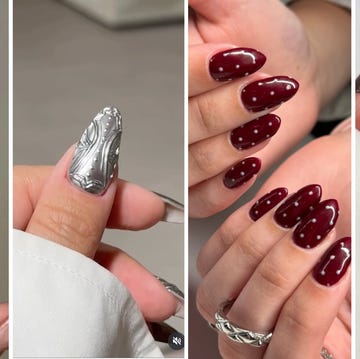
If you’ve ever marvelled at the glossy perfection of a gel manicure – the kind that dries in seconds under a UV lamp and holds its shine for weeks — then one ingredient you'll have been thanking is Trimethylbenzoyl Diphenylphosphine Oxide. It’s a mouthful, so in the beauty world it goes by a snappier nickname: TPO.
Last year, the European Union introduced a ban on the substance being used in nail salons. And as of this past weekend, new regulations have come into place in the UK which mean manufacturers can no longer sell new products containing TPO.
Salons now have until Valentine's Day next year to use up their TPO-containing polishes, after which they'll have to switch to TPO-free formulas. The good news is that many brands already offer TPO-free options, so you'll still be able to get the gel manicures you know and love.
Here's everything you need to know about the science behind the TPO ban.
Why is TPO being banned?
At its core, TPO is a photoinitiator – it helps nail gels harden quickly under UV light and keeps colours from fading. Yet studies have shown a link between the chemical and long-term fertility damage in animals, which is why regulators have now reclassified it as a CMR (Carcinogen, Mutagen, Reprotoxic) category 1B substance. Under EU law, that’s a dealbreaker. Unless the industry can prove a substance is irreplaceable and safe in cosmetics, it can’t stay on the market.
'The industry could not defend the continued use of this ingredient,' explained Francesca Rapolla, scientific affairs manager at the UK’s Cosmetic, Toiletry & Perfumery Association (CTPA). There are alternatives, so TPO is prohibited,' she said in nail magazine, Scratch.
What to Read Next
Yet some nail industry figures oppose the ban. As leading scientific expert in the nail and eyelash industry, Doug Schoon, points out, adverse reactions are rare when products are applied by trained professionals. He, along with some nail wholesalers, believes the ban is more about precaution than panic – and that regulators are acting before evidence of consumer harm.
Still, salons and brands have had to face the challenge of reformulating. Without TPO, the performance of nail gels doesn’t necessarily change, but the formulas behind them do. And that means professionals – and their clients – will need to get used to new ingredient names, and potentially 'TPO-free' labels.
Some brands are prepared. Last year, a spokesperson for The Gel Bottle told WH: 'We are pleased to confirm that 100% of The GelBottle products sold in the EU are now fully TPO-free and compliant with the September 2025 regulation and for our UK/US customers, we are actively transitioning all products to new TPO-free formulations, with reformulated versions already rolling out. We expect the entire range to be fully TPO-free ahead the UK regulatory deadline.'
Reformulation, however, comes at a cost – one that may trickle down to small salons and independent nail professionals. It’s why Schoon and others remain frustrated, arguing that the studies behind the ban don’t reflect real-world use in nail products.
In short, your manicure won’t vanish – it’ll just be powered by a new generation of ingredients.
Perdita Nouril is the Beauty Editor for Women’s Health UK. She has worked in the beauty industry for 15 years since graduating from the University of Nottingham. Adept at exploring the colossal world of beauty, she loves to scratch beneath the surface to debunk the myths, decode the science and challenge traditional notions of beauty. You can always find her preaching sermons on the power of a red lip, extolling the virtues of a decent serum and championing the very best female beauty founders.
You can find Perdita on Instagram on @perditanouril